Wearable Motion Foundation Models

Inertia-1: An Open Exploration of Wearable Motion Foundation Models

A controlled, fully open study of the full lifecycle of wearable motion foundation models — data, sensing, objectives, and scale — built into a practical cookbook for motion representation learning.

Zongzhe Xu1*, Aakarsh Anand1*, Sarah Jiang2*, Chuntung Zhuang3, Zitao Shuai1, Sriram Sankararaman1, Yuzhe Yang1†
1University of California, Los Angeles  ·  2Duke University  ·  3Johns Hopkins University   * Equal contribution  ·  † Correspondence: yuzhey@ucla.edu
18.2M+
Hours of motion
115K+
Participants
15
Datasets
18
Downstream tasks
10
Pretraining methods
1,000+
Trained models
Overview

From a fragmented landscape to a unified, open study

Wearable motion sensing is a natural fit for foundation models, yet its pretraining and scaling principles remain poorly understood.

Abstract. Wearable motion sensing provides a continuous and scalable window into human behavior and health, making it a natural fit for foundation models, yet its pretraining and scaling principles remain poorly understood. Prior work studies isolated design choices, such as sensor placement or sampling frequency, often under fixed settings and narrow downstream tasks that fail to capture real-world sensing diversity. We introduce Inertia-1, a fully open exploration of wearable motion foundation models. Using massive corpora of accelerometer data from global sources spanning more than 18.2M hours, we build a controlled framework for studying the full lifecycle of wearable motion foundation models, covering data choices such as sensor modality, device placement, sampling rate, and window length; model choices such as architectures and model size; and training choices such as pretraining objective and data scale.

Extensive evaluations across 15 datasets spanning human activity recognition, freezing-of-gait detection, and disease prediction reveal intriguing findings for building motion foundation models that generalize across tasks and sensing conditions. Collectively, Inertia-1 not only presents state-of-the-art recipes for diverse downstream tasks, but also serves as a comprehensive, practical, and open cookbook for wearable motion representation learning.

Why this is hard. The field is fragmented in layers: data pipelines differ in sampling rate, window length, sensor modality, body placement, and axis representation; methods differ in objective, architecture, and representation domain; datasets differ in scale and clinical context; and downstream evaluation spans activity recognition, gait analysis, and disease prediction. Large cohorts provide population-scale longitudinal data but often release compressed, downsampled, or vector-magnitude traces, while HAR and freezing-of-gait datasets offer high-frequency signals but are small in scale.

Our approach. Rather than proposing a single new architecture, Inertia-1 turns this fragmented landscape into a unified space of controlled exploration — treating motion foundation models as a joint problem over data, sensing configurations, pretraining algorithms, and downstream tasks, so the same pretrained representation can transfer from short-term activity recognition to long-term disease prediction.

Figure 1. Overview of Inertia-1: large-scale accelerometer pretraining, diverse self-supervised objectives, controlled sensing setups, and downstream evaluation across activity recognition, gait analysis, and disease prediction.
Jul 2026Code released on GitHub.
Jun 2026Project website is live.
SoonPaper to be released on arXiv.
The Framework

One controlled space over data, sensing, objectives & tasks

Inertia-1 is an open, extensible framework built on four pillars, evaluated across a rigorous grid of sensing and scaling choices.

1

Pretraining

10 representative methods under shared training and evaluation settings, covering 5 classes of objectives — general self-supervised and motion-specific.

2

Data pipelines

A rigorous grid over sampling rate, window length, sensor modality, axis dimensionality, and body placement.

3

Scale

To our knowledge the largest waveform-level wearable motion collection to date: 18.2M hours from 115,000+ people across 15 datasets.

4

Downstream tasks

10 human activity recognition datasets, 3 freezing-of-gait datasets, and 7 disease prediction tasks.

Pretraining objectives

Autoregressive prediction

Predict future motion from past context

Learns transferable behavioral dynamics by forecasting upcoming motion patches.

ARG (GRU)ART (Transformer)

Contrastive learning

Align related views, separate unrelated ones

Spans general and wearable-specific objectives built around motion augmentations and temporal structure.

SimCLRSSL-WearablesRelCon

Self-distillation

Teacher–student consistency, no negatives

Tests whether non-contrastive representation learning transfers to wearable motion.

DINO

Masked reconstruction

Recover masked signal segments

Covers both time-domain and time–frequency reconstruction-style objectives.

PatchTSTSelf-PABLSM

Supervised baselines

Trained from scratch per task

Reference points to separate whether pretraining helps from which form of pretraining helps.

ViTCNN

Data regimes & downstream tasks

10

Activity recognition

Short-term motion semantics — walking, sitting, running, household and exercise movements.

CAPTURE-24HAR70+HARTHHHARMHEALTHOPPORTUNITYPAMAP2RecoFitWISDMWEAR
3

Freezing of gait

Transient, clinically meaningful disruptions in locomotion — subtle abnormalities beyond standard activities.

Daphnet FoGOdayFoGFoGTurning
7

Disease prediction

Long-term, population-level health modeling from longitudinal behavioral signatures.

SleepDepressionDepr. severityParkinson’sDiabetesOsteoarthritisOsteoporosis

Pretraining sources: NHANES (primary; raw high-frequency accelerometry from ~14,000 participants over multiple days) and the UK Biobank (100,000+ participants of large lower-resolution cohort data) for scaling studies.

Axes of exploration
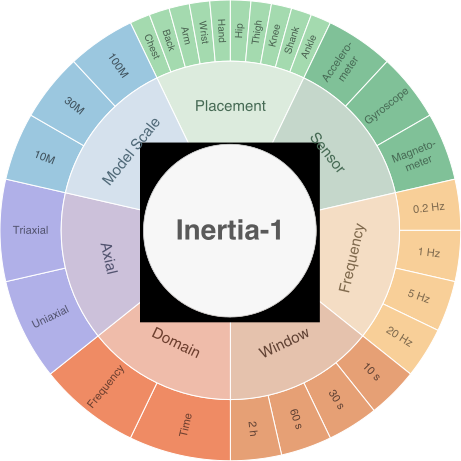
Placement
wristhandarmchestbackhipthighkneeshankankle
Sensor modality
accelerometergyroscopemagnetometer
Sampling frequency
0.2 Hz1 Hz5 Hz20 Hz
Window length
10 s30 s60 s2 h
Representation domain
timefrequency
Axis dimensionality
uniaxialtriaxial
Model scale
10M30M100M
Transfer
linear probefull finetuneMIL
Coverage breadth of Inertia-1
Figure 2. Coverage breadth of Inertia-1 across the controlled sensing and modeling axes.
Default setup
30 s windows 20 Hz sampling triaxial wrist accelerometer pretrained on NHANES linear probing + full finetuning MIL heads on frozen backbones for disease
Findings

Lessons from 1,000+ trained models

With one unified framework, Inertia-1 reveals what makes wearable motion foundation models robust, transferable, and useful across real-world conditions.

01

Pretraining is beneficial, but not universal

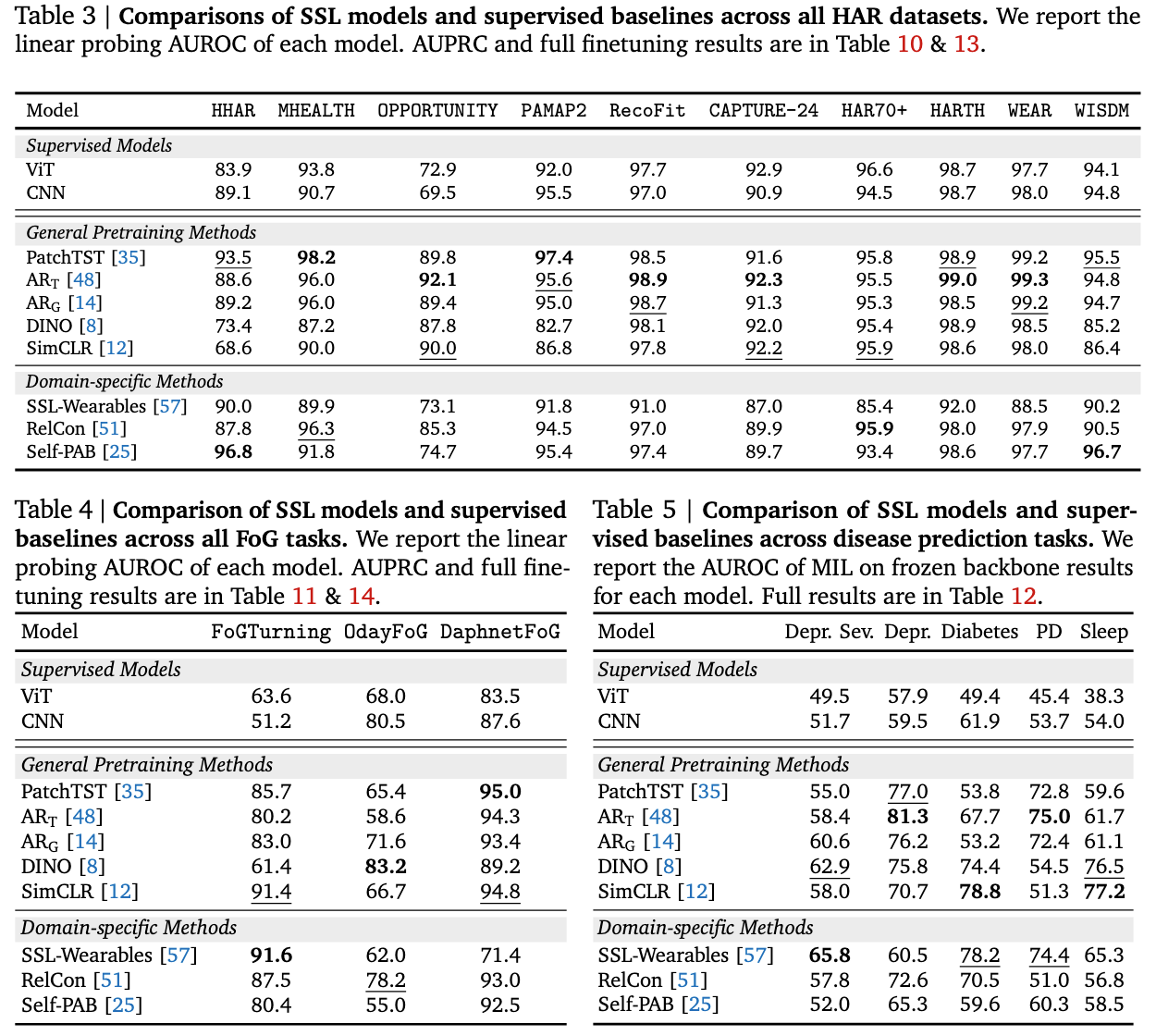
Self-supervised pretraining consistently improves over supervised training from scratch, yet no single objective dominates across all task families and metrics.

02

Data representation is a first-order choice

Triaxial signals outperform magnitude summaries, while sampling rate and window length matter differently across task granularities.

03

Scale helps, but not all scale is equal

More (and more diverse) pretraining data yields steadier gains than larger model sizes, and multi-sensor fusion drives strong gains in sensor-expansion settings.

04

SOTA requires coordinated design

Performance depends on the joint choice of data fidelity, sensing setup, objective, and scale — not any single recipe.

05

Inertia-1 as an open cookbook

As the most diverse and unified testbed to date, Inertia-1 offers a practical foundation for studying, extending, and deploying wearable motion foundation models.

4.1

Robust pretraining objectives

Under the default setting (20 Hz, 30 s, triaxial, pretrained on NHANES), self-supervised pretraining consistently outperforms supervised training from scratch across HAR, FoG, and disease prediction. Specialized or predictive objectives tend to be more robust for short-term recognition, while differences shrink for disease prediction. Crucially, the benefit of objective design grows with task specialization: SSL variance and gains are modest for HAR but widen sharply for FoG and disease.

+4.0
SSL gain · HAR
+16.4
SSL gain · FoG
+19.7
SSL gain · Disease
SSL versus supervised across task families
4.2

When does scaling help?

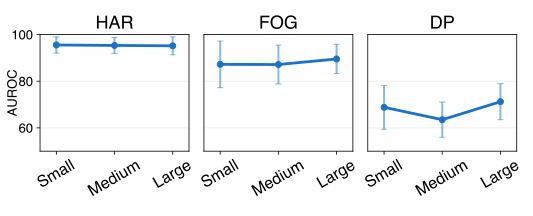
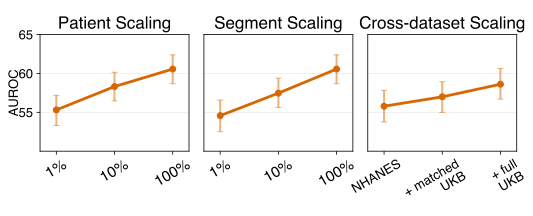
Increasing encoder size alone (ART from 10M to 100M parameters) leaves linear-probe performance largely flat under a fixed corpus, and full finetuning can even degrade on small downstream datasets. Expanding the pretraining data is the more reliable lever: scaling the number of individuals, the number of segments per person, and mixing NHANES with UK Biobank all improve transfer. Scaling motion FMs is data-first, but not model-free — capacity must be matched to signal diversity and task structure.

Model scaling across tasks
Figure 3. Model scaling across tasks.
Data scaling across settings
Figure 4. Data scaling across settings.
4.3

A unified lens over sensing design

Sensing choices are not secondary implementation details — they directly shape what motion FMs can transfer. Triaxial inputs consistently beat vector-magnitude summaries. Performance generally improves with sampling frequency, but pretrained representations stay competitive even at 1 Hz for HAR, while disease prediction benefits more from higher temporal resolution. Window length is task-dependent (30 s and 60 s are strong overall), and time-domain modeling better preserves gait and disease signals than frequency-domain reconstruction.

4.4

Multi-stream sensing

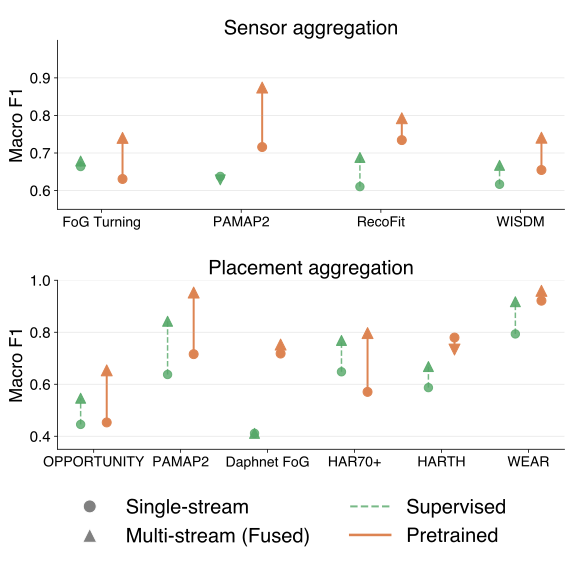
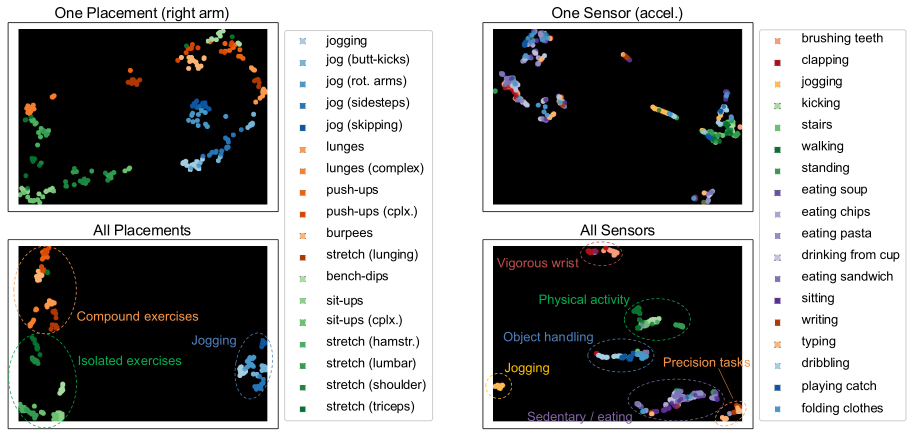
Wearable datasets often contain richer signals than a single wrist accelerometer. Fusing multiple synchronized streams — across sensor modalities and body placements — consistently improves performance, showing that different streams provide complementary rather than redundant information. A model pretrained only on wrist accelerometry transfers to unseen placements and modalities, and fusion produces better-separated activity clusters in the representation space.

Wrist-accelerometer pretraining transfers across sensors and placements
Figure 7. Wrist-accelerometer pretraining transfers across sensors & placements.
Multi-stream fusion improves representation geometry
Figure 8. Multi-stream fusion improves representation geometry.
Paper

Read & cite Inertia-1

BibTeX

@article{xu2026inertia1,
  title   = {Inertia-1: An Open Exploration of Wearable Motion Foundation Models},
  author  = {Xu, Zongzhe and Anand, Aakarsh and Jiang, Sarah and Zhuang, Chuntung and
             Shuai, Zitao and Sankararaman, Sriram and Yang, Yuzhe},
  journal = {arXiv preprint},
  year    = {2026}
}

Acknowledgments: We gratefully acknowledge the support of Amazon Science Hub and UCLA DataX.